court practice · D. Delaware · 8 min read
How to monitor antitrust cases in D. Delaware
Learn how to monitor antitrust cases in D. Delaware. LexRadar Alerts monitors dockets, courts and agencies in near real time, then delivers rule-matched aler...
Why how to monitor antitrust cases in D. Delaware matters for U.S. counsel
If your practice touches antitrust cases, you already know the operational problem: D. Delaware activity and related docket monitoring can move faster than any associate can refresh portals. Teams searching for “how to monitor antitrust cases in D. Delaware” are usually trying to close a gap between official systems (PACER / CM/ECF, agency newsrooms, Federal Register) and the people who must act.
AmLaw groups and in-house counsel still rely on delayed ECF emails, generic research-suite alerts, or ad-hoc RSS folders. That stack creates false confidence. A scheduling order and a dispositive motion both “alert” the same way — unless you add rules, classification and delivery that match how litigators actually work.
This guide explains what good monitoring looks like for antitrust cases in and around D. Delaware, which sources matter, how to reduce noise, and how modern alert engines compare on cost and control.
The source stack behind docket monitoring
Effective coverage for how to monitor antitrust cases in D. Delaware usually combines several layers. First, docket-level monitoring (CourtListener / RECAP and PACER RSS where available) catches new filings, orders and hearing entries. Second, opinion coverage from appellate and selected state courts surfaces doctrinal shifts that affect strategy. Third, regulatory streams — Federal Register documents and agency press from SEC, FTC, DOJ, CFPB, FDA, EPA and peers — catch enforcement and rulemaking before they show up in case law.
For antitrust cases, keyword and entity resolution matter as much as the feed itself. A bare “new document” alert is noise. Counsel need context: parties, judges, practice area, impact level, and whether the event touches a client, counterparty or watchlist matter.
Secondary queries that often cluster with this topic include AmLaw docket monitoring software, CourtListener webhook alerts, antitrust cases docket alerts, and real-time ECF notifications. Building one watch strategy that answers all of them is more efficient than maintaining five disconnected tools.
Common failure modes in D. Delaware monitoring
Manual refresh does not scale. Friday evening filings and holiday agency drops are classic miss points. Paralegal coverage windows rarely match the court’s calendar.
Generic alerts from full research platforms often bury critical docket monitoring under library-wide noise. When everything pings, nothing is actionable. Partners then re-introduce manual filters — defeating the purpose of automation.
PACER RSS and similar products can work well for power users, but many firms report cost spikes once seats, dockets and jurisdictions expand. Boutique litigators and mid-size practice groups need enterprise-grade signal without enterprise-only pricing.
A practical playbook for antitrust cases
1) Inventory matters and counterparties that must never go dark. 2) Map each to venues (D. Delaware and adjacent courts) and agencies that issue related guidance. 3) Define rules: event types (new complaint, PI motion, proposed rule, enforcement release), minimum severity, and keyword sets. 4) Choose channels: individual email for leads, Slack/Teams for practice groups, webhooks for knowledge systems. 5) Prefer instant delivery for high-severity events and digests for broad surveillance.
Measure success as “critical events caught before Monday morning,” not “number of emails sent.” Track false positives weekly for the first month and tighten rules. Good monitoring is iterative.
For how to monitor antitrust cases in D. Delaware, document who owns each watch. Orphaned alerts are as dangerous as no alerts — they create a paper trail of ignored risk.
What “good” looks like operationally
Every alert should answer four questions in under thirty seconds: What happened? Which client or matter? How severe? What is the official source link? If an alert fails that test, it will be muted.
Classification by practice area and impact score turns docket monitoring into routing logic. Securities teams should not drown in employment minute orders. Privacy counsel should not miss FTC algorithmic rulemaking because it arrived as a generic “notice.”
Integration matters. Delivery into Slack or Teams places signal where associates already live; API/webhook delivery lets litigation support push events into DMS, matter dashboards or internal KM hubs.
Why LexRadar Alerts solves how to monitor antitrust cases in D. Delaware — at roughly half the cost of PACER RSS
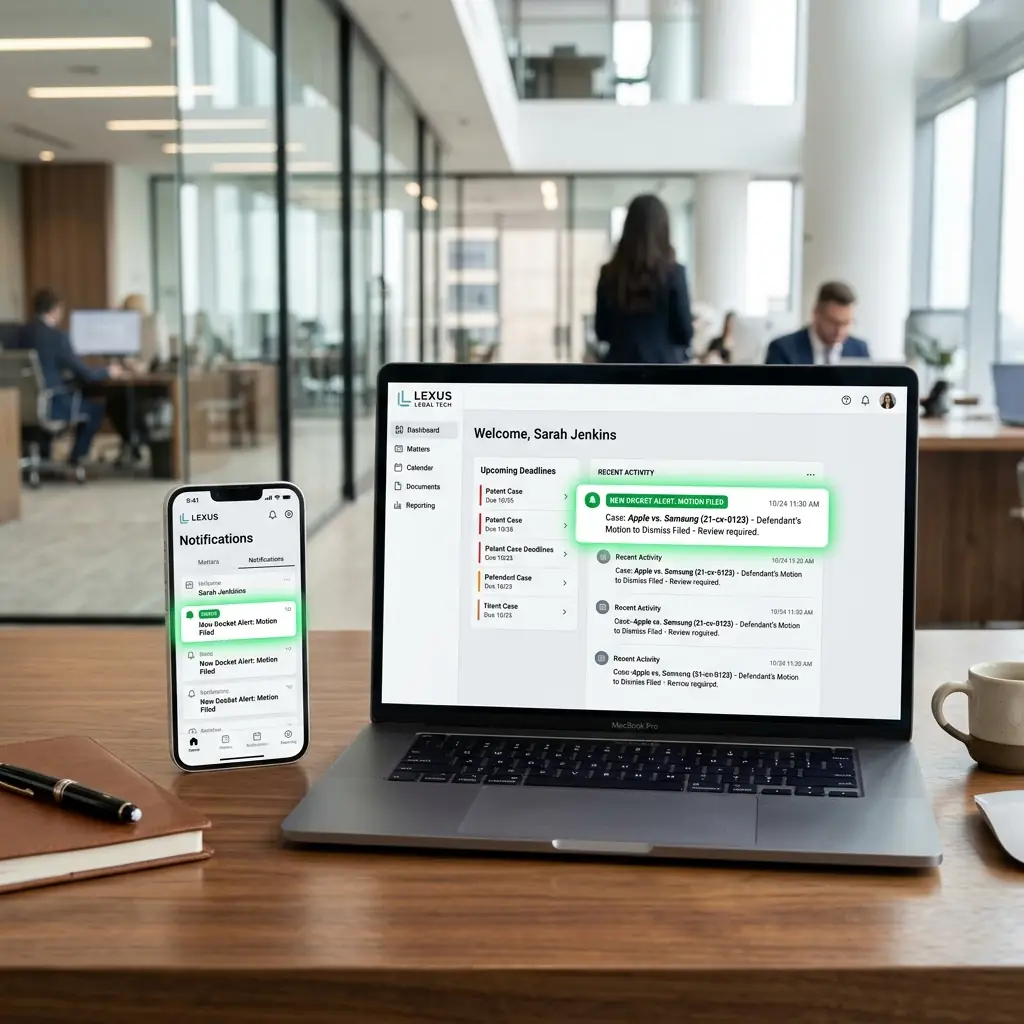
LexRadar Alerts is purpose-built for the job behind “how to monitor antitrust cases in D. Delaware”: monitor dockets, courts, Federal Register and agency sources; enrich each event with practice-area and impact context; apply your rules; deliver only matches to email, Slack, Teams or API.
Compared with PACER RSS and broad research suites (Westlaw / Lexis / Bloomberg alert add-ons), LexRadar is an alert engine — not a full library you must rebuy for every seat. Practice-group plans start near a few hundred dollars per month; solo plans land well below typical multi-seat research alert stacks. For many teams that is about half the effective cost of competitor seats once you price true coverage for antitrust cases around D. Delaware.
You keep control: flexible JSON-backed rules, instant or digest cadence, and white-glove onboarding for AmLaw and GC pilots. The goal is simple — no missed filing or rule change that should have reached counsel, without paying enterprise research prices for a monitoring problem.
Start a free alert for one practice group, or book a 30-minute demo. If you are evaluating PACER RSS renewals, run a side-by-side pilot on the same matters and measure catch rate vs. monthly cost.